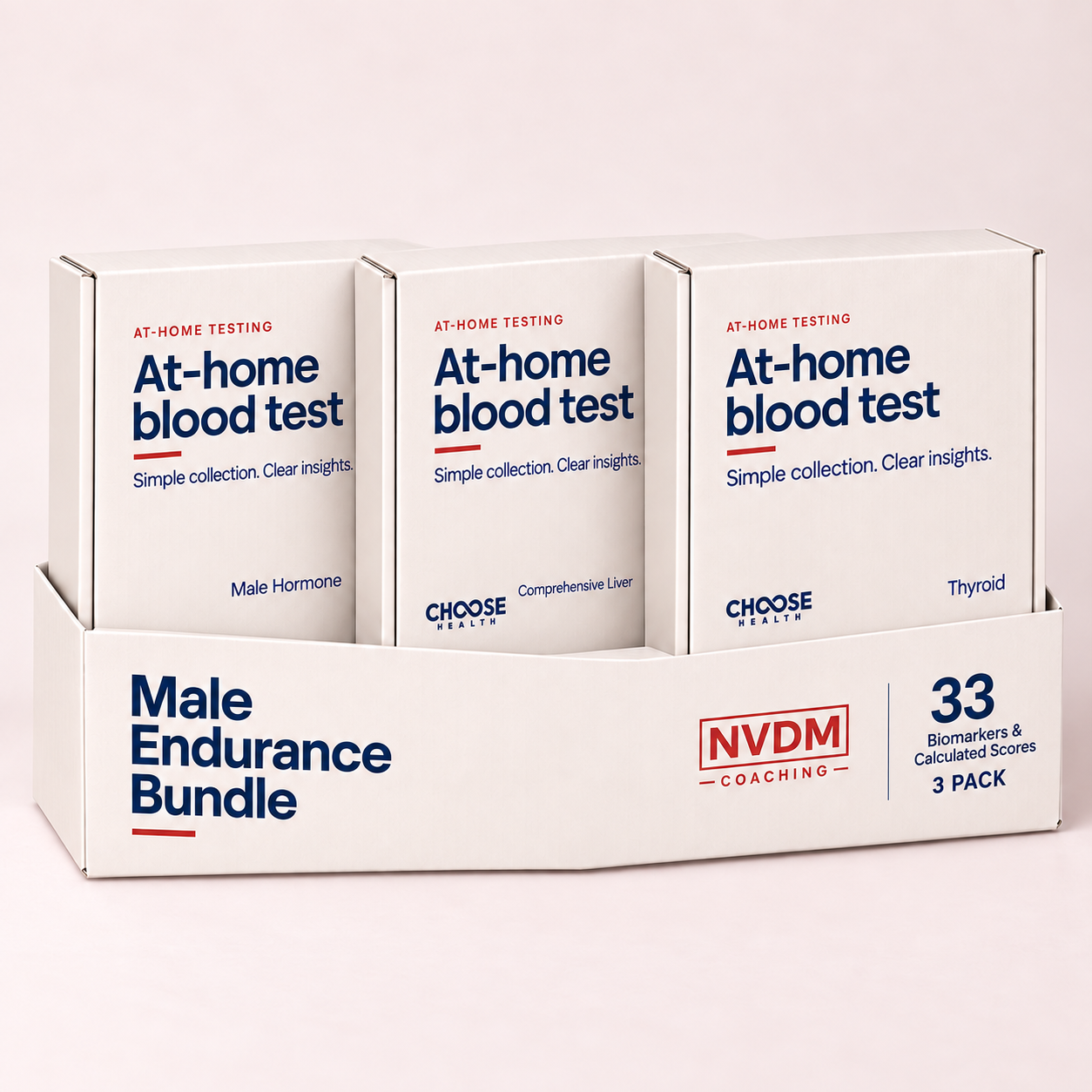
NVDM athlete collection · 33 biomarkers & scores
Male Endurance Bundle
Understand the demands of your next build.
Male Hormone Panel (7) + Comprehensive Liver Function Panel (22) + Thyroid Panel (4).
NVDM pricing shown. Review the final total at checkout.
Your starting point
Who is this for?
For male endurance athletes with questions about iron, persistent fatigue, reduced libido, thyroid function or recovery across demanding training blocks.
The endurance connection
Why it matters.
Combines iron status with Total and Free Testosterone, LH and thyroid markers. Useful when recovery or libido changes alongside training load. The included hormone panel is Male Hormone, not Male Wellness.
IOC: energy availability and athlete health ↗Know what you’re measuring
Every marker, explained.
Total Testosterone, Free Testosterone, PSA, Estradiol, SHBG, LH, Visceral Fat Estimate, Albumin, AST, ALT, GGT, Total Bilirubin, Fasting Glucose, HbA1c, Fasting Insulin, HOMA-IR, LDL, HDL, Triglycerides, VLDL, ApoA1, ApoB, Iron, UIBC, Ferritin, Transferrin Saturation, Fatty Liver Index, Hepatic Steatosis Index, AST:ALT Ratio, TSH, Free T3, Free T4, TPO Antibodies.
Counts follow the store. Profiles and calculated estimates are labeled separately from individual blood measurements.
| Marker | What it can tell you | Why it matters for an athlete |
|---|---|---|
| Total TestosteroneHormones | Total circulating testosterone, including protein-bound hormone. | In men, persistently low morning levels with low libido or poor recovery warrant assessment. In women, a low result is not a standalone RED-S indicator. Endocrine Society: testosterone assessment ↗ |
| Free TestosteroneHormones | The unbound fraction of testosterone, interpreted with total testosterone and SHBG. | Helps clarify a male hormone assessment when binding proteins affect the total result. There is no established female athletic-performance target. MedlinePlus: SHBG ↗ |
| PSAProstate health | A prostate protein used in individualized prostate assessment. | Provides a separate health check, not a performance marker. Age, risk and symptoms guide interpretation. MedlinePlus: PSA and preparation ↗ |
| EstradiolHormones | An estrogen involved in reproductive function and bone health. | Low levels alongside missing periods raise concern about energy availability and bone stress injury risk. Cycle timing is essential. IOC: energy availability and athlete health ↗ |
| SHBGHormones | A protein that binds sex hormones and affects their availability. | Helps interpret total versus free testosterone; it is not a training-readiness score. MedlinePlus: SHBG ↗ |
| LHHormones | Pituitary signaling that stimulates testosterone production in men. | With low testosterone, LH helps a clinician investigate the source of the change, including possible suppression of reproductive signaling. Endocrine Society: testosterone assessment ↗ |
| Visceral Fat EstimateCalculated estimate | An estimate related to fat around internal organs, not a direct imaging measurement. | Adds metabolic-health context. It should not become a weight-loss target during a demanding build. IOC: energy availability and athlete health ↗ |
| AlbuminLiver | A liver-produced protein involved in fluid balance and transport. | Hydration and illness affect interpretation. It is not a direct measure of protein intake. MedlinePlus: liver tests ↗ |
| ASTLiver / muscle | An enzyme present in liver and muscle. | May rise after muscle-damaging exercise. Note recent racing or strength training. Research: exercise can raise AST and ALT ↗ |
| ALTLiver | An enzyme used to assess liver-cell injury. | Hard exercise can also increase ALT, so training history matters. Research: exercise can raise AST and ALT ↗ |
| GGTLiver | An enzyme that contributes to liver and bile-duct assessment. | Alcohol and some medicines can affect it. It is not a direct overtraining marker. MedlinePlus: liver tests ↗ |
| Total BilirubinLiver | A breakdown product from red blood cells, processed by the liver. | An abnormal result needs context including liver function and red-cell breakdown. MedlinePlus: liver tests ↗ |
| Fasting GlucoseBlood sugar | Blood glucose at the time of collection. | Fasting, illness and recent exercise affect the snapshot; it does not measure glycogen stores. NIDDK: HbA1c and the three-month view ↗ |
| HbA1cBlood sugar | Average blood sugar over approximately three months. | Tracks longer-term metabolic health, not race fueling. Iron deficiency and altered red-cell turnover can affect results. NIDDK: HbA1c and the three-month view ↗ |
| Fasting InsulinBlood sugar | Insulin concentration under fasting conditions. | Used with glucose to assess metabolic context, not whether you ate enough carbohydrates for training. NIDDK: HbA1c and the three-month view ↗ |
| HOMA-IRCalculated score | An estimate of insulin resistance derived from fasting insulin and glucose. | Useful metabolic context; not a validated RED-S screen or measure of workout fueling. NIDDK: HbA1c and the three-month view ↗ |
| LDLCholesterol | Cholesterol carried in LDL particles. | Helps assess long-term cardiovascular health. Fitness does not rule out lipid risk; abnormal levels often have no symptoms. MedlinePlus: cholesterol testing ↗ |
| HDLCholesterol | Cholesterol carried in HDL particles. | Helps assess long-term cardiovascular health. Fitness does not rule out lipid risk; abnormal levels often have no symptoms. MedlinePlus: cholesterol testing ↗ |
| TriglyceridesCholesterol | Circulating fats influenced by meals and metabolic health. | Helps assess long-term cardiovascular health. Fitness does not rule out lipid risk; abnormal levels often have no symptoms. MedlinePlus: cholesterol testing ↗ |
| VLDLCholesterol | Cholesterol carried in triglyceride-rich VLDL particles. | Helps assess long-term cardiovascular health. Fitness does not rule out lipid risk; abnormal levels often have no symptoms. MedlinePlus: cholesterol testing ↗ |
| ApoA1Cholesterol | A major protein in HDL particles. | Helps assess long-term cardiovascular health. Fitness does not rule out lipid risk; abnormal levels often have no symptoms. MedlinePlus: cholesterol testing ↗ |
| ApoBCholesterol | A measure related to the number of atherogenic lipoprotein particles. | Helps assess long-term cardiovascular health. Fitness does not rule out lipid risk; abnormal levels often have no symptoms. MedlinePlus: cholesterol testing ↗ |
| IronIron status | Iron circulating in the blood at collection. | Read with the other iron results. Low iron availability can contribute to fatigue and reduced endurance, even before anemia develops. AIS: iron screening and follow-up ↗ |
| UIBCIron status | The unused capacity of iron-binding proteins. | Read with the other iron results. Low iron availability can contribute to fatigue and reduced endurance, even before anemia develops. AIS: iron screening and follow-up ↗ |
| FerritinIron status | A marker of stored iron that can also rise with inflammation. | Read with the other iron results. Low iron availability can contribute to fatigue and reduced endurance, even before anemia develops. AIS: iron screening and follow-up ↗ |
| Transferrin SaturationIron status | The percentage of iron transport capacity occupied by iron. | Read with the other iron results. Low iron availability can contribute to fatigue and reduced endurance, even before anemia develops. AIS: iron screening and follow-up ↗ |
| Fatty Liver IndexCalculated score | A calculated estimate of the likelihood of fatty liver. | Adds liver-health context. This is not a direct scan of liver fat; exercise-related enzyme changes can affect interpretation. MedlinePlus: liver tests ↗ |
| Hepatic Steatosis IndexCalculated score | A calculated screening estimate for fatty liver. | Adds liver-health context. This is not a direct scan of liver fat; exercise-related enzyme changes can affect interpretation. MedlinePlus: liver tests ↗ |
| AST:ALT RatioCalculated score | A comparison of the two enzyme results. | Adds liver-health context. This is not a direct scan of liver fat; exercise-related enzyme changes can affect interpretation. MedlinePlus: liver tests ↗ |
| TSHThyroid | The pituitary signal directing thyroid hormone production. | Useful when fatigue comes with cold intolerance, unexplained weight changes or altered heart rate. Read with thyroid hormones. American Thyroid Association: thyroid tests ↗ |
| Free T3Thyroid | The unbound active thyroid hormone. | May fall with prolonged low energy availability. A low value needs interpretation alongside symptoms and fueling. IOC: energy availability and athlete health ↗ |
| Free T4Thyroid | The unbound form of the main hormone released by the thyroid. | Together with TSH, helps investigate thyroid dysfunction that can affect energy and exercise tolerance. American Thyroid Association: thyroid tests ↗ |
| TPO AntibodiesThyroid | Antibodies associated with autoimmune thyroid disease. | Helps investigate why thyroid function may be changing. Repeated antibody levels usually do not guide training decisions. American Thyroid Association: thyroid tests ↗ |
Baseline · Build · Follow-up
Make testing part of your season.
This is a planning framework for a 12–16-week build. Your results and symptoms determine whether you need an earlier check.
01
Before the build
Collect during a recovered, representative week before increasing training. This gives you a comparison point.
02
During a 12–16-week build
If symptoms develop or previous results were borderline, arrange a targeted check with enough time to act before race week.
03
Between training blocks
Review the trend after recovery. Repeat the markers that answer your next question; a full panel is not automatically needed each time.
How often should you retest?
- Iron statusHigher-risk endurance athletes may benefit from quarterly iron screening. Following prescribed oral iron treatment, a repeat around 8–12 weeks can assess response; earlier follow-up may be needed for anemia or symptoms. AIS: iron screening and follow-up ↗
- TestosteroneConfirm an unexpectedly low result on a separate fasting morning sample. Timing after a fueling or recovery change is individualized; there is no guaranteed number of weeks for recovery. Endocrine Society: testosterone assessment ↗
- ThyroidUse symptoms and previous results to set follow-up. TSH commonly takes about 6–8 weeks to reassess after a thyroid medication dose change. This is not a universal lifestyle-retest schedule; TPO antibodies usually do not need serial monitoring. American Thyroid Association: thyroid tests ↗
- Average blood sugarAllow roughly three months to assess a longer-term HbA1c trend. It cannot show whether yesterday’s fueling was enough. NIDDK: HbA1c and the three-month view ↗
New or persistent symptoms deserve assessment between scheduled tests. There is no universal quarterly requirement for every marker.
A result worth comparing
Before you collect.
- Follow your kit instructionsUse the collection and fasting instructions supplied with your kit. Drink water normally; do not arrive dehydrated or deliberately overhydrate.
- Record your contextNote collection time, recent training, illness, sleep, medications and supplements. Do not stop prescribed medication without advice.
- Choose a representative dayFor a resting comparison, avoid collecting immediately after a race, hard workout, overnight travel or while acutely ill. Wait until sleep and hydration are back to your usual pattern.
- Keep the days before iron testing easyAIS recommends low to moderate activity in the prior 24 hours and avoiding muscle-damaging exercise for 2–3 days. Follow the kit’s fasting instructions.
- Tell your clinician about muscle sorenessAST and ALT can remain elevated for a week or more after unusual muscle-damaging exercise. A fixed 48-hour gap does not guarantee a resting baseline.
- Use a consistent morning collectionMorning fasting samples are important when assessing low testosterone. Poor sleep and recent illness should be recorded.
- Prepare for PSAAvoid ejaculation for 48 hours before collection. Tell your clinician about recent vigorous cycling, urinary symptoms or prostate procedures and follow their preparation advice.
- Check biotin supplementsBiotin can interfere with thyroid assays. Ask the lab how long to pause your particular dose before collection; do not assume every supplement needs the same hold.
Turn results into a next step.
Bring your results together with training load, fueling, symptoms and any supplements. Choose one clear action with your clinician or sports dietitian, then agree which markers to repeat and when.
Persistent fatigue, missing periods, recurrent bone stress injuries or unexpectedly abnormal results need clinical follow-up. A normal panel does not rule out RED-S or explain every change in performance.
Evidence and further reading
- NIDDK: HbA1c and the three-month view ↗
- Research: exercise can raise AST and ALT ↗
- AIS: iron screening and follow-up ↗
- MedlinePlus: cholesterol testing ↗
- MedlinePlus: liver tests ↗
- Endocrine Society: testosterone assessment ↗
- MedlinePlus: PSA and preparation ↗
- IOC: energy availability and athlete health ↗
- MedlinePlus: SHBG ↗
- American Thyroid Association: thyroid tests ↗
These sources explain the biomarkers and testing context. They do not validate these specific kits as a diagnosis of RED-S or a guarantee of improved performance.