



Modern finger-prick (capillary) blood tests have been directly validated against standard venous blood draws, with peer-reviewed studies showing strong agreement between the two methods for most liver markers. When a sample is collected correctly and processed in an accredited laboratory, a finger-prick liver test is a genuinely reliable way to screen for liver stress and track enzyme trends over time.
The limitations aren't mainly about whether capillary blood "counts" as real data. They’re about collection technique and scope.
Before taking an at-home finger-prick liver test it helps to know how results are determined to ensure accuracy, how those results are validated and the limitations in order to set realistic expectations.
How Finger-Prick Testing Actually Works
A finger-prick blood test involves collecting a sample by puncturing the fingertip with a small lancet and collecting a small volume of blood (typically well under a tenth of a milliliter) into a collection device. This is different from a venous draw, where a phlebotomist inserts a needle into a vein and collects a much larger volume of blood.
Capillary blood itself is not chemically identical to venous blood. It's a mixture of blood from small arteries, veins and capillaries, along with a small amount of fluid from the surrounding tissue. For most markers, the difference is negligible. For a handful of specific markers, it matters, which is exactly why validation studies exist to establish where capillary results can be trusted as accurate.
How Finger-Prick Blood Tests Are Validated and Regulated
In the United States, laboratory testing, regardless of whether the sample was collected by a phlebotomist or by the patient at home, is processed under the Clinical Laboratory Improvement Amendments (CLIA) framework. CLIA certification is designed to ensure that the laboratory processing a sample meets defined standards for accuracy, reliability and personnel competency. The certification process is jointly overseen by the Centers for Medicare & Medicaid Services, the FDA and the CDC.
At-home collection kits don't bypass this system. The sample you collect at home is still processed by a certified clinical laboratory using the same analyzers and quality-control processes used for samples drawn in a clinic.
Is Finger-Prick Testing Accurate For Liver Enzymes? What the Validation Studies Show
A peer-reviewed study published in the Journal of Applied Laboratory Medicine directly compared a capillary blood collection device against standard venipuncture for a full liver enzyme panel, using paired samples from the same patients. The results showed very strong agreement between the two collection methods for the core liver markers:
| Liver Marker | Agreement Between Capillary and Venous Samples |
|---|---|
| ALT | Strong agreement (concordance correlation coefficient >0.95) |
| AST | Very strong agreement in centrifuged samples (CCC >0.99) |
| ALP | Very strong agreement (CCC >0.99) |
| Total bilirubin | Very strong agreement (CCC >0.99) |
| Albumin | Strong agreement (CCC >0.95) |
A concordance correlation coefficient (CCC) close to 1.0 means the two methods are essentially measuring the same thing. A CCC above 0.95 is generally considered an excellent agreement in laboratory science.
The same study also reported strongly favorable patient experience with capillary collection. A test people can actually complete correctly at home is more useful than a theoretically superior test that goes uncollected.

What a Finger-Prick Liver Test Can Actually Tell You
When used correctly a finger-prick liver panel can serve a number of purposes:
-
Screening
You can screen for early signs of liver enzyme elevation, prompting further evaluation if something looks off.
-
Establishing Baseline Metrics
Before starting a new medication, changing your lifestyle or cutting back on alcohol consumption you can use a finger-prick liver test to get baseline metrics.
-
Tracking Trends Over Time
Know whether enzymes are moving in a reassuring or concerning direction across repeated tests.
-
Knowing When to Schedule Clinical Evaluations
Blood testing that results in abnormal or persistently rising metrics will indicate it’s time for a clinical evaluation.
All this is genuinely useful information, and it's the same type of information a venous blood draw liver panel gives you. The collection method doesn't change what the test measures, only how the sample is obtained.
What a Finger-Prick Liver Test Can’t Tell You
While you can learn a lot from a finger-prick liver test, it’s not a catchall. Blood tests measure enzymes, and liver enzymes are a chemical signal, not a picture of the liver.
For example, no type of blood test can diagnose fatty liver disease. Enzymes can be completely normal even when fat has already accumulated in the liver, which is exactly why fatty liver is so often discovered incidentally. Diagnosing it requires imaging such as ultrasound, FibroScan or MRI-PDFF that can actually visualize or quantify fat in liver tissue.
The same logic applies to fibrosis staging. Composite calculations like FIB-4 or the NAFLD Fibrosis Score combine blood markers with factors like age and platelet count to estimate fibrosis risk, and can be useful for deciding whether further evaluation is warranted. But they're a statistical estimate, not a substitute for imaging or biopsy when a definitive answer is needed.
For a closer look at what liver testing can catch early and why that matters, see our article on Home Liver Testing, Symptoms of Liver Damage & Why Early Detection Matters.
Where Capillary Testing Gets Tricky: Hemolysis and AST
The biggest source of error in capillary blood collection is hemolysis. This is the rupture of red blood cells during collection, which releases their internal contents into the sample. Aspartate aminotransferase (AST) is concentrated roughly 40 times higher inside red blood cells than in the surrounding plasma. Even mild hemolysis can release enough AST to falsely elevate the result, independent of what's actually happening in the liver.
This isn't a flaw in capillary blood test analysis. It’s a collection and handling issue. Hemolysis in capillary samples is typically caused by:
-
Squeezing or "milking" the finger too aggressively to get enough blood.
-
Not discarding the first drop, which can be contaminated with tissue fluid.
-
Prolonged or repeated collection attempts at the same puncture site.
-
Improper storage or delayed processing after collection.
In published comparisons, capillary samples show meaningfully higher rates of hemolysis and sample rejection than venous draws. It’s a reminder that the collection step, not the underlying science, is where most avoidable error creeps in.
Accredited labs screen incoming samples for hemolysis and flag or reject affected results rather than reporting a falsely elevated number, which is one reason using a testing provider that discloses its quality-control process matters.
Collection Techniques That Help Ensure Accurate Results
-
Wash your hands in warm water first. Warmth improves blood flow to the fingertip, reducing how much squeezing you'll need to do.
-
Let your hand hang down for a moment before pricking. This uses gravity to help blood pool naturally at the fingertips.
-
Puncture with one firm, deliberate motion. Multiple shallow pricks increase discomfort and the risk of a poor sample, and it doesn’t improve blood flow.
-
Wipe away the first drop of blood. It can be contaminated with tissue fluid or residual moisture, which dilutes the sample.
-
Use gentle, rhythmic pressure from the base of the finger toward the tip. Don't squeeze directly at the puncture site. Aggressive squeezing is the single biggest cause of hemolysis in self-collected samples.
-
Fill the collection device fully and promptly. Then follow the storage and return instructions exactly as provided.
How to Use Finger-Prick Liver Tests Strategically
Finger-prick liver tests are a tool. That means how you use them makes a difference in what you get out of them. To get the most value out of finger-prick liver tests:
-
Use It For What It's Good At
Finger-prick blood tests should be used for screening, getting baselines, tracking and monitoring over time. Understand the limitations and that you can’t diagnose with blood tests.
-
Follow Collection Instructions Precisely
This single factor has more influence on result quality than the collection method itself.
-
Interpret a Single Result in Context
One mildly abnormal marker is far less informative than a trend across several tests.
-
Bring Meaningfully Abnormal or Persistent Results to a Healthcare Provider
They can determine whether imaging or further evaluation is the appropriate next step.
-
Retest Periodically
If you're monitoring a medication, a lifestyle change or a known condition this is where finger-prick testing's convenience genuinely pays off.
.jpeg)
Test Your Liver Health With an Accurate At-Home Finger-Prick Test
Now that you know what a finger-prick liver test can (and can't) tell you, choosing the right one comes down to matching the panel to your goals. At Choose Health we have two finger-prick liver tests that cover all of the essential markers.
Most comprehensive option
Comprehensive Liver Function Test
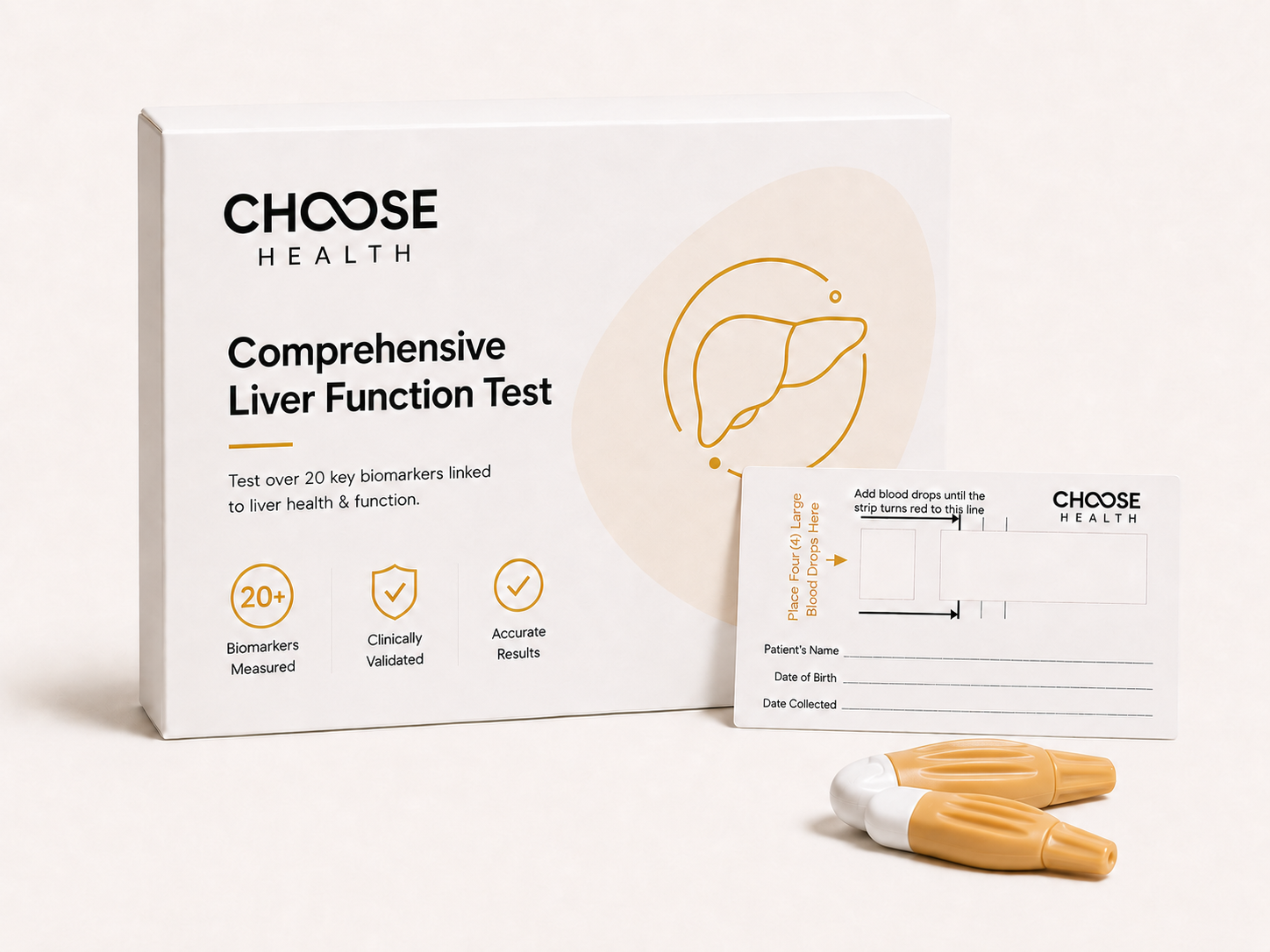
Comprehensive Liver Function Test — In addition to the essential liver markers, this test includes albumin and total protein for a fuller picture of liver function.
Use code LIVER30 for $30 off.
Explore the Comprehensive TestStreamlined option
Liver Function Test
Liver Function Test — This streamlined at-home blood test is great for knowing if the liver is under stress and tracking function with foundational biomarkers.
Use code LIVER15 for $15 off.
View the Basic Liver TestBoth are collected with the same validated finger-prick method and processed by an accredited laboratory. Choose Health gives you assurance with real, trustworthy data on your liver enzymes without the cost or scheduling hassle of a clinic visit.
Start Testing and Tracking Liver Function Today!
Compare both at-home liver tests and select the level of detail that fits your goals.
Finger-Prick Liver Testing FAQ
Is a finger-prick blood test as accurate as a venous blood draw?
For most core liver markers like ALT, ALP and bilirubin validation studies show strong to very strong agreement between capillary and venous samples when collection is done correctly. AST requires more careful handling because it's especially sensitive to hemolysis, a collection artifact rather than a flaw in the underlying method.
Why do some finger-prick liver tests get rejected or flagged?
The most common reasons are an insufficient sample volume or hemolysis caused by squeezing the finger too hard during collection. Accredited labs are designed to catch these issues and flag or reject affected samples rather than report an inaccurate result.
Can a finger-prick test diagnose fatty liver disease?
No. Liver enzyme tests, regardless of collection method, measure signs of liver cell stress, not the presence of fat in the liver. Diagnosing fatty liver disease requires imaging, such as ultrasound, FibroScan or MRI-PDFF.
Are at-home finger-prick tests regulated the same way as tests done in a clinic?
Samples from at-home collection kits are processed by laboratories operating under the same CLIA certification framework used for clinic-based blood draws, using the same analyzers and quality-control standards.
How can I make sure my finger-prick sample is accurate?
Follow the provided collection instructions exactly. Technique is also important. Warm you hands up before the finger prick, don’t squeeze the finger and discard the first drop of blood before collecting the sample.