
.png)


How Your Liver Activates Thyroid Hormone
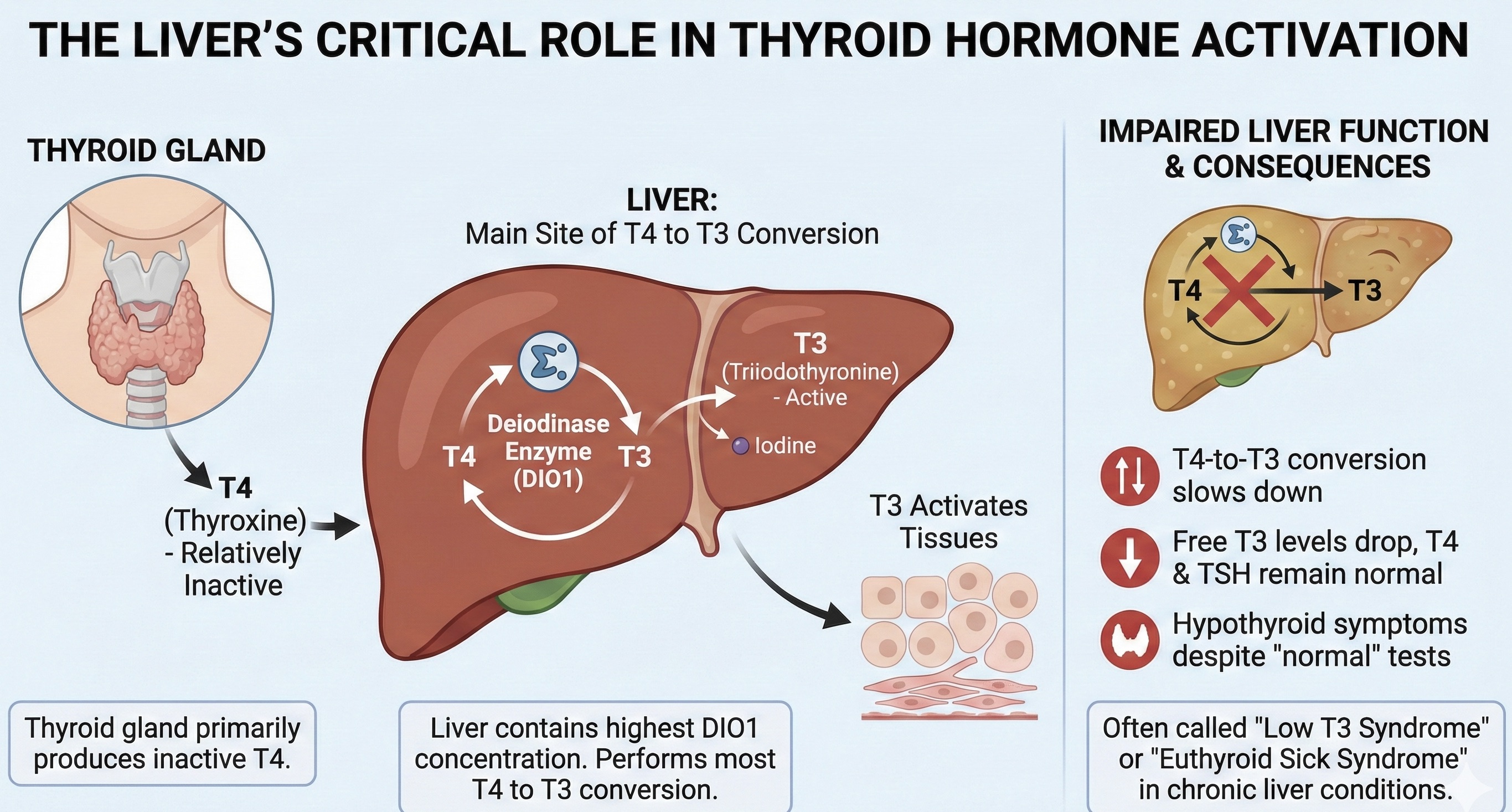
Your thyroid gland primarily produces T4 (thyroxine), which is relatively inactive. For thyroid hormone to work in your tissues, T4 must be converted to T3 (triiodothyronine) by enzymes called deiodinases.
Your liver contains the highest concentration of deiodinase type 1 (DIO1) and performs most of this conversion. When liver function is impaired:
- T4-to-T3 conversion slows down
- Free T3 levels may drop while T4 and TSH remain normal
- You may experience hypothyroid symptoms despite "normal" standard thyroid tests
Check the liver side of the picture
Measure ALT, AST and GGT, then compare your liver markers with your thyroid results.

Fatty Liver and Thyroid Dysfunction
Research consistently shows a strong link between hypothyroidism and fatty liver disease (NAFLD). The relationship is bidirectional:
How low thyroid causes fatty liver
- Reduced metabolic rate slows fat burning
- Decreased lipid oxidation in the liver
- Increased lipogenesis (fat creation)
- Impaired VLDL secretion, trapping fat in liver cells
How fatty liver impairs thyroid function
- Reduced T4-to-T3 conversion
- Inflammation affects thyroid hormone receptors
- Altered thyroid hormone binding proteins
Why Standard Thyroid Tests May Miss the Problem
Standard thyroid screening typically includes TSH and sometimes free T4. But these tests can appear normal while T3 levels are suboptimal due to poor liver conversion.
Consider this scenario:
(normal)
(normal)
(low end of range)
(elevated)
(elevated)
This pattern suggests the liver isn't efficiently converting T4 to T3. The person may have hypothyroid symptoms despite "normal" TSH and T4. Without testing liver enzymes and free T3, this connection would be missed.
Key Markers to Test Together
| Marker | What It Tells You |
|---|---|
| ALT | Liver cell stress (men <55 U/L, women <45 U/L optimal) |
| GGT | Oxidative stress, metabolic health (men <14 U/L, women <9 U/L optimal) |
| TSH | Thyroid-stimulating hormone (1.8–3.0 mIU/L optimal) |
| Free T4 | Inactive thyroid hormone (0.61–1.12 ng/dL optimal) |
| Free T3 | Active thyroid hormone (2.5–3.9 pg/mL optimal) |
Add liver markers to the thyroid picture
The Liver Function Test measures ALT, AST and GGT. The Comprehensive Liver Test adds a broader view of metabolic, cardiovascular and iron health.
A Note on Thyroid Treatments for Liver Disease
The connection between thyroid hormones and liver health is so strong that thyroid hormone receptor beta like resmetirom have been developed specifically to treat NASH (advanced fatty liver disease). These drugs activate thyroid hormone pathways in the liver to promote fat burning and reduce liver inflammation.
This underscores how important thyroid hormone signaling is for liver health.
What You Can Do
If your thyroid markers are suboptimal and your liver enzymes are elevated, addressing liver health may improve thyroid function naturally. Weight loss, reducing alcohol, and improving metabolic health can restore the liver's ability to convert T4 to T3.
If your liver enzymes are normal but thyroid markers are off, the issue is more likely primary thyroid dysfunction requiring different evaluation.
When liver markers are elevated
Testing can help you track whether changes to weight, alcohol, and metabolic health are moving ALT, AST, and GGT in the right direction.
When liver markers are normal
The issue is more likely primary thyroid dysfunction requiring different evaluation.
Liver Function Test
The focused option for checking the liver markers discussed in this article.
- ALT, AST and AST:ALT ratio
- GGT, HbA1c and hsCRP
- A clear liver baseline to track over time
Comprehensive Liver Test
The broader option for liver, metabolic, cardiovascular, and iron markers.
- Core liver enzymes and function markers
- Glucose, insulin and HbA1c
- Lipids, ApoA, ApoB and iron markers
Test both systems. Understand where to focus.
Thyroid markers show one side of the relationship. Liver enzymes add the context that standard thyroid screening may miss.
.png)
.jpeg)


.jpeg)