




What you'll learn:
- How the liver controls cholesterol and triglyceride levels.
- Why liver enzyme elevations are linked to cardiovascular events.
- Which specific markers signal both liver stress and heart risk.
- What to test to get a complete picture of your liver-heart profile.

How the Liver Controls Cholesterol Production
The liver is responsible for synthesizing roughly 70-80% of the cholesterol in your body. It packages cholesterol into very low-density lipoprotein (VLDL), which is then released into the bloodstream. VLDL converts to LDL, the form of cholesterol most associated with arterial plaque buildup.
When the liver is inflamed or accumulating fat, VLDL production increases. This is one reason people with fatty liver disease (NAFLD/MASLD) often have elevated triglycerides and LDL alongside their liver enzyme findings. Understanding your VLDL cholesterol levels is one of the clearest ways to see how liver dysfunction translates into cardiovascular risk.
Fatty Liver Disease and Cardiovascular Risk
A large meta‑analysis in the Journal of Hepatology found that NAFLD is associated with a significantly increased risk of fatal and non‑fatal cardiovascular events (OR ≈1.6 overall, rising to ≈2.6 in more severe NAFLD), highlighting that fatty liver is an important cardiovascular risk marker beyond traditional factors.
The mechanism is not limited to cholesterol alone. A fatty liver produces excess pro-inflammatory cytokines, including TNF-alpha and IL-6, which damage the lining of blood vessels and accelerate atherosclerosis. Fatty liver is also closely tied to insulin resistance, which is itself a major driver of cardiovascular disease.
Optimal ranges for the key lipid markers the liver produces:
GGT as an Independent Cardiovascular Predictor
GGT (gamma-glutamyl transferase) is typically associated with liver and bile duct health, but it is also an independent predictor of cardiovascular events. A large cohort study in Arteriosclerosis, Thrombosis,and Vascular Biology found that elevated GGT is associated with increased risk of heart disease and stroke, even in people whose other risk factors appear normal.
GGT reflects oxidative stress at the cellular level. When GGT is elevated, it often means the liver is under oxidative load, which contributes to systemic inflammation and arterial damage over time.
Choose Health's GGT reference ranges:
- Men optimal: <14 U/L | Elevated: 14-27 U/L
- Women optimal: <9 U/L | Elevated: 9-17 U/L
Checking your ALT blood test results alongside GGT gives a more complete picture of liver stress patterns than either marker alone.
ALT, AST, and Metabolic Cardiovascular Risk
ALT and AST elevations point to active liver cell stress, and they frequently co-occur with the metabolic factors that drive heart disease. Elevated ALT is closely tied to insulin resistance, abdominal adiposity, and dyslipidemia. All three of these are primary cardiovascular risk factors.
The AST:ALT ratio adds another layer. A ratio above 2:1 can indicate more advanced liver stress, while a ratio below 1 often reflects fatty liver-related inflammation. Either pattern, when combined with cholesterol and triglyceride findings, helps identify who needs closer cardiovascular monitoring.
Optimal liver enzyme ranges:
- ALT men: <55 U/L | Women: <45 U/L
- AST men: <45 U/L | Women: <35 U/L
CRP: The Inflammatory Bridge Between Liver and Heart
C-reactive protein (CRP) is produced by the liver in response to inflammation. Elevated CRP is one of the most established markers of cardiovascular risk. The American Heart Association classifies a CRP above 3 mg/L as high cardiovascular risk.
When the liver is under chronic stress, whether from fat accumulation, alcohol, or metabolic dysfunction, CRP output increases. This makes CRP a direct measure of how liver-driven inflammation is affecting heart risk.
Choose Health CRP ranges:
- Optimal: <1 mg/L
- Elevated (moderate cardiovascular risk): 1-3 mg/L
- Highly elevated (high cardiovascular risk): >3 mg/L
The liver also plays a role in cortisol regulation, which further affects both inflammation and blood pressure. For more on that relationship, see how your liver affects cortisol and why testing both matters.
What to Test to Assess Both Liver and Heart Risk
A full assessment requires looking at liver enzymes and lipid markers together. Seeing ALT in isolation does not show how liver function is affecting cholesterol production, and seeing LDL alone does not explain why it is elevated.
The markers most useful for a liver-heart assessment include:
- ALT and AST - direct measures of liver cell stress.
- GGT - reflects oxidative stress and bile duct load, independent cardiovascular predictor.
- VLDL and triglycerides - show how the liver is processing and releasing fats.
- LDL and total cholesterol - reflect downstream effects of liver cholesterol synthesis.
- CRP - measures liver-driven systemic inflammation.
- Fasting glucose and HbA1c - capture insulin resistance, which connects liver and cardiovascular dysfunction.
Conclusion
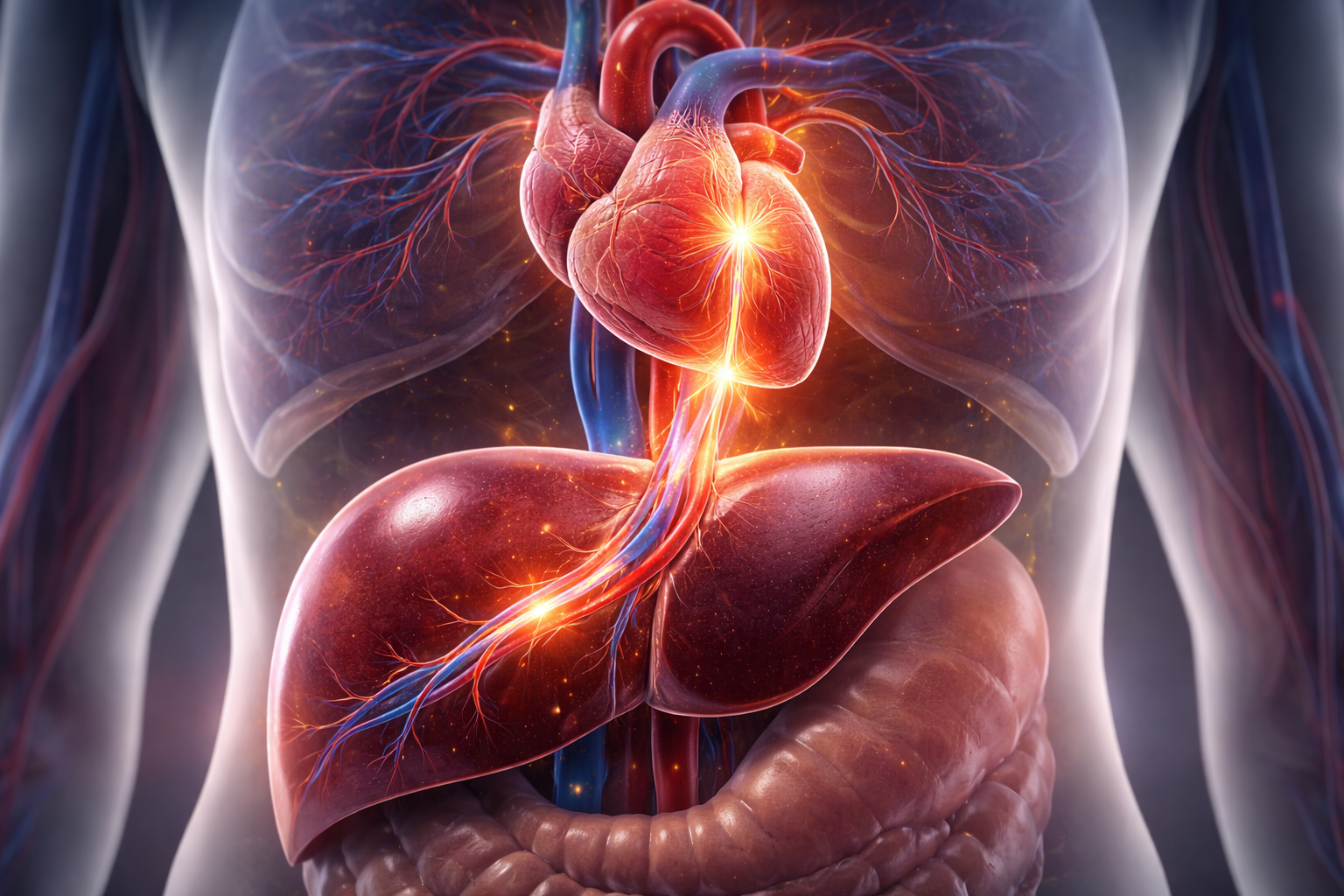
The liver is not separate from cardiovascular health. It produces the majority of circulating cholesterol, drives systemic inflammation through CRP and cytokines, regulates triglycerides, and reflects the insulin resistance patterns that accelerate arterial disease. Liver enzyme elevations, particularly GGT, are measurable cardiovascular risk signals on their own.
Tracking these markers together over time gives a more complete picture of metabolic and heart health than any single panel.
Want to know your liver's score? Take our liver health quiz below to get started.
.png)
.jpeg)


.jpeg)