
.png)



Short answer
The Fatty Liver Index runs from 0 to 100. The formula was developed in 2006 and reports 84% accuracy for detecting hepatic steatosis in the general population.
What you need to calculate it
Four inputs, two from a blood test and two you can measure at home.
| Input | Unit | Source |
|---|---|---|
| Triglycerides | mg/dL | Blood test |
| GGT | U/L | Blood test |
| BMI | kg/m² | Height and weight |
| Waist circumference | cm | Tape measure at the navel |
The formula combines these into a probability score. The math is complex, the inputs are not.
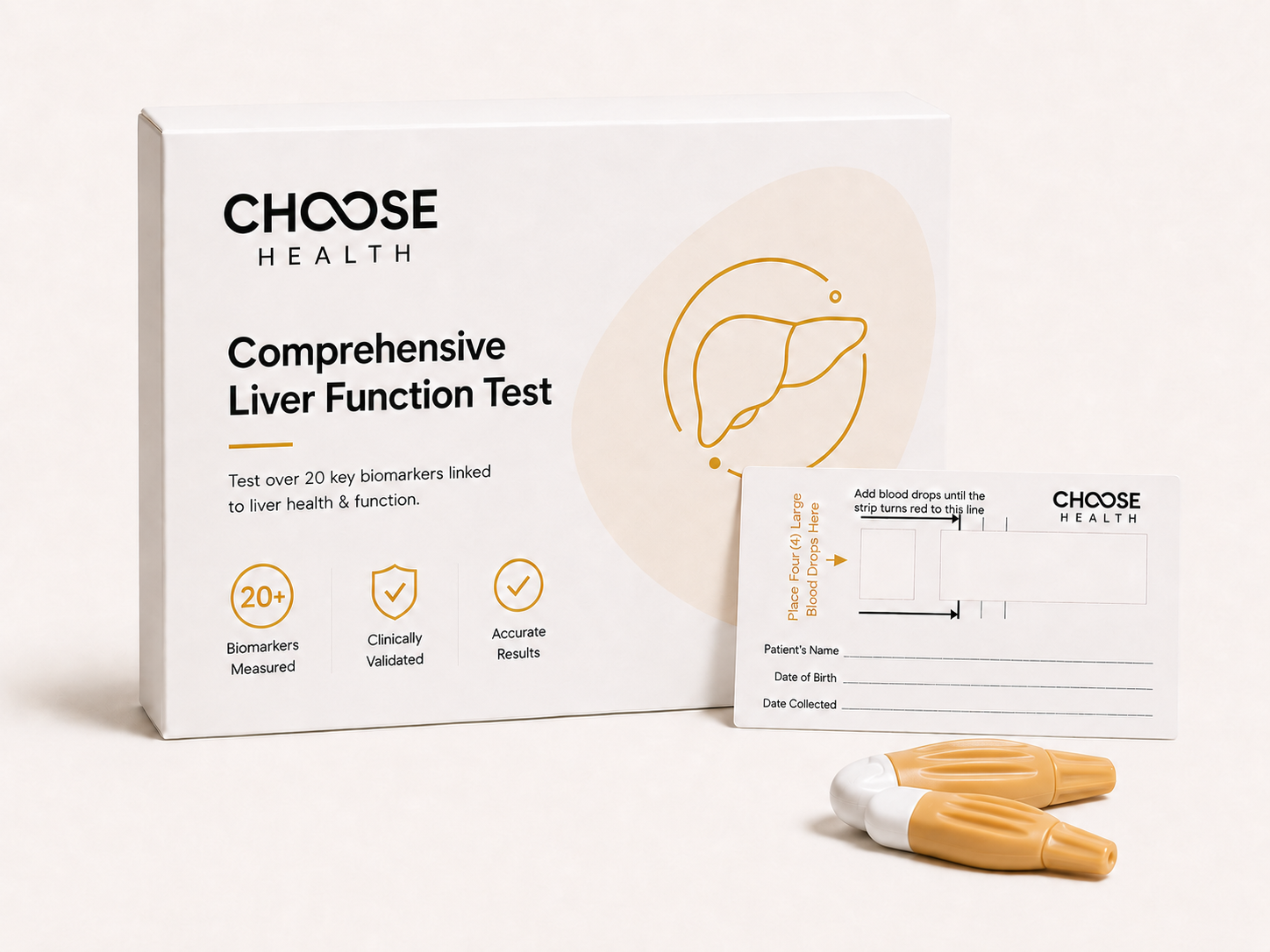
The Comprehensive Liver Function Test measures GGT and triglycerides, and returns your Fatty Liver Index and Hepatic Steatosis Index as calculated scores. See the full marker list

How to interpret your score
| FLI score | Result | What it means |
|---|---|---|
| <30 | Fatty liver unlikely | Rules out steatosis with high confidence |
| 30 to 59 | Indeterminate | Cannot confirm or rule out |
| ≥60 | Fatty liver likely | High probability, follow-up recommended |
An FLI below 30 carries a negative likelihood ratio of 0.2, which is what makes it a strong rule-out. An FLI of 60 or above carries a positive likelihood ratio of 4.3, which makes fatty liver probable rather than certain.
Why these four inputs
Each component reflects a different aspect of metabolic and liver health.
How much fat the liver is handling
Elevated levels indicate the liver is processing more fat than it can export. High triglycerides often travel with insulin resistance.
The early signal
This enzyme rises with fat accumulation and oxidative stress, and it's often the first marker to move in early fatty liver.
Overall body mass
Higher body mass increases fatty liver risk. On its own, BMI doesn't tell you where fat is stored, which is why the fourth input exists.
Where the fat sits
Visceral fat around the midsection has a stronger link to fatty liver than overall weight. The original study found waist was among the strongest predictors.
FLI versus other assessments
FLI is a screening tool, not a diagnostic test. It estimates probability, and other methods answer questions it can't.
| Method | What it does | Limitation |
|---|---|---|
| FLI | Estimates fatty liver probability | Cannot detect inflammation or fibrosis |
| Ultrasound | Visualizes fat in the liver | Misses mild cases |
| ALT / AST | Measures liver cell stress | Can read normal in many fatty liver cases |
| FibroScan | Measures liver stiffness | Requires specialized equipment |
FLI works best as a first-line screen. If your score is 60 or above, the usual next step is an ultrasound.
What to do based on your score
Fatty liver unlikely
Continue the habits you have and retest annually.
Inconclusive
- Recheck in 3 to 6 months after lifestyle changes
- Consider a liver ultrasound for clarity
- Test ALT, AST and other liver enzymes for context
Fatty liver likely
- Request a liver ultrasound to confirm
- Review metabolic markers including HbA1c and fasting insulin
- Discuss interventions with your doctor
- Retest in 3 to 6 months to track progress
Fatty liver is often reversible. A 5 to 10% reduction in body weight can meaningfully reduce liver fat.
When to retest
FLI is as useful for monitoring as it is for the first screen. Retest after 3 to 6 months of lifestyle changes, after 5% or more body weight loss, when starting or stopping medications that affect the liver, or after any intervention targeting metabolic health.
Triglycerides and GGT both respond to dietary change, which is what makes this worth tracking rather than checking once.
Get both blood inputs and your score
GGT, triglycerides, ALT, AST and metabolic markers, with FLI and HSI returned as calculated scores.
Frequently asked questions
Is the Fatty Liver Index accurate?
The original study reported 84% accuracy. It performs best as a rule-out, meaning a score below 30 is more informative than a score above 60 is conclusive.
Can I calculate FLI without blood tests?
No. You need triglycerides and GGT from a blood test. BMI and waist circumference you can measure at home.
What's the difference between FLI and HSI?
FLI uses triglycerides, GGT, BMI and waist circumference. The Hepatic Steatosis Index uses ALT, AST, BMI, sex and diabetes status. Both screen for fatty liver, and seeing them together gives you two independent estimates.
Does a high FLI mean liver damage?
Not necessarily. FLI detects fat accumulation, not inflammation or scarring. Additional testing determines whether anything has progressed further.
Know your liver numbers
The Fatty Liver Index gives you a non-invasive way to estimate fatty liver risk, and a number you can move. If you don't know your triglycerides and GGT, that's the first step, and it's the one part of the calculation you can't do with a tape measure.
20+ biomarkers · DBS finger-prick
Comprehensive Liver Function Test
Both blood inputs for the Fatty Liver Index, plus the metabolic and liver markers that put the score in context. FLI and HSI are returned as calculated scores.
- FLI inputs
- GGT, triglycerides
- Calculated scores
- Fatty Liver Index, Hepatic Steatosis Index, AST:ALT ratio
- Liver
- Albumin, AST, ALT, GGT, total bilirubin
- Metabolic
- Fasting glucose, fasting insulin, HbA1c
At-home finger-prick collection. Results in days.
This article is for informational purposes and is not a substitute for medical advice, diagnosis or treatment. The Fatty Liver Index is a screening estimate, not a diagnosis, and cannot detect inflammation or fibrosis. Discuss your score and any follow-up testing with your healthcare provider.
.jpeg)


.jpeg)