



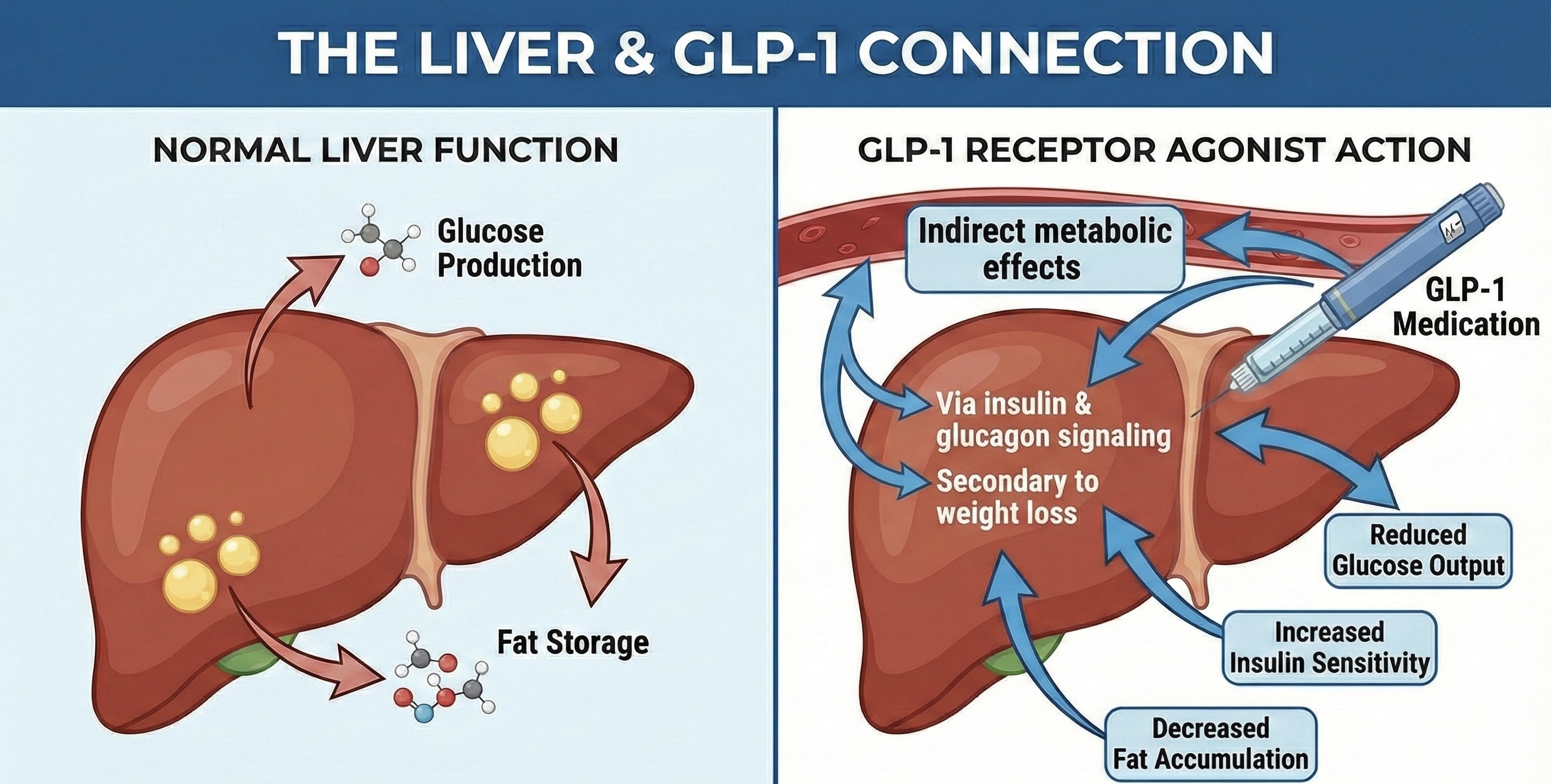
How GLP-1 Medications Affect the Liver
GLP-1 receptor agonists like semaglutide (Ozempic, Wegovy) and tirzepatide (Mounjaro, Zepbound) are among the most effective medications available for weight loss and metabolic health improvement. While most attention focuses on appetite suppression and blood sugar regulation, these medications also influence liver health, insulin sensitivity, hydration status, inflammation, and overall metabolic function.
GLP-1 receptor agonists work by slowing gastric emptying, reducing appetite, and improving insulin sensitivity. These effects create downstream changes in the liver. Positive effects observed in studies include:
- Reduced liver fat accumulation
- Lower ALT and AST levels in patients with fatty liver
- Improved insulin sensitivity, which reduces liver workload
- Decreased inflammation markers
Research published in The Lancet found that semaglutide significantly reduced liver fat and improved fibrosis markers in patients with metabolic dysfunction-associated steatohepatitis (MASH). However, individual responses vary. Rapid weight loss, dehydration, and changes in fat metabolism can temporarily stress the liver in some cases.
Test your liver health from home
Measure ALT, AST, GGT, your AST:ALT ratio, HbA1c, hsCRP, and visceral fat with one simple finger-prick test.
Finger-prick · results in days · no subscription required · use code LIVER15 for $15 off

Why Liver Monitoring Matters on GLP-1s
GLP-1 medications cause significant metabolic shifts. Your liver adapts to these changes, and monitoring helps you understand how. Reasons to track liver enzymes while on GLP-1s:
- Rapid fat mobilization during weight loss can temporarily affect liver function
- Pre-existing fatty liver may improve, and testing confirms progress
- Dehydration from reduced appetite can concentrate liver enzymes
- Combining GLP-1s with other medications increases liver processing demands
- Some individuals experience transient enzyme elevations that resolve with time
If you're already monitoring pancreatic enzymes like amylase and lipase on GLP-1 therapy, adding liver markers gives you a complete picture of how your body is responding.
Key Liver Markers to Monitor
The same liver enzymes used in standard liver function testing apply here. The table below shows the enzymes worth tracking while on semaglutide (Ozempic, Wegovy) or tirzepatide (Mounjaro, Zepbound).
| Marker | Type | Optimal | Elevated | High |
|---|---|---|---|---|
| ALT Alanine aminotransferase | Liver-specific | 45-55 | 90-110 | 200+ |
| AST Aspartate aminotransferase | Multi-organ | 35-45 | 70-90 | 200+ |
| GGT Gamma-glutamyl transferase | Early warning | 9-14 | 30-50 | 100+ |
ALT (Alanine Aminotransferase)
ALT is the most liver-specific enzyme. It rises when liver cells are inflamed or stressed.
Most people on GLP-1s see ALT levels stay stable or decrease. An increase warrants attention, especially if combined with symptoms like fatigue or abdominal discomfort. Learn more about what these enzyme levels mean.
AST (Aspartate Aminotransferase)
AST reflects both liver and muscle health. The AST:ALT ratio helps distinguish liver-specific issues from muscle breakdown.
A ratio greater than 2:1 (AST significantly higher than ALT) may indicate alcohol-related liver stress. A ratio less than 1:1 is typical of fatty liver. You can work out your own ratio with the AST:ALT ratio calculator.
GGT (Gamma-Glutamyl Transferase)
GGT is sensitive to oxidative stress, bile duct function, and alcohol use. It often elevates before ALT or AST in metabolic dysfunction.
GGT tends to improve on GLP-1 therapy as metabolic health improves. Persistent elevation may indicate ongoing oxidative stress or bile duct issues.
What the Research Shows
Clinical trials have consistently shown liver benefits from GLP-1 medications in patients with fatty liver disease. For people with pre-existing fatty liver, GLP-1 medications may offer therapeutic benefits beyond weight loss, and regular testing confirms whether these improvements are occurring. Source: New England Journal of Medicine.
When to Test Liver Function on GLP-1s
Testing timing depends on your baseline health and how your body responds to the medication.
If you have pre-existing fatty liver or insulin resistance, more frequent testing helps track improvement.
Signs Your Liver May Need Attention
Most people on GLP-1s experience no liver issues. However, contact your healthcare provider if you notice:
- Persistent fatigue beyond typical medication adjustment
- Upper right abdominal discomfort
- Dark urine or pale stools
- Yellowing of skin or eyes (jaundice)
- Nausea that worsens rather than improves over time
These symptoms are uncommon but warrant evaluation.
The Connection Between Liver Health and Metabolic Function
Your liver and metabolic health are deeply connected. Fatty liver often develops alongside insulin resistance, elevated triglycerides, and high blood sugar. GLP-1 medications address multiple parts of this equation simultaneously.
Tracking liver enzymes alongside metabolic markers like HbA1c and lipids gives you a complete picture. Some people also benefit from methylation testing to understand how their liver processes nutrients and medications.
Testing at Home vs. Traditional Labs
At-home liver testing makes regular monitoring practical. You can track trends over time without scheduling multiple lab visits.
Choose Health's at-home Liver Function Test measures seven markers:
- ALT
- AST
- AST:ALT ratio (calculated for you)
- GGT
- HbA1c
- hsCRP
- Visceral fat
Results arrive within days, and your dashboard tracks changes over time. This is especially useful during the active weight-loss phase, when more frequent monitoring provides the most value.
Test your liver health from home
Measure ALT, AST, GGT, your AST:ALT ratio, HbA1c, hsCRP, and visceral fat with one simple finger-prick test.
Finger-prick · results in days · no subscription required · use code LIVER15 for $15 off

Conclusion
GLP-1 medications typically improve liver health, especially in people with fatty liver disease. But individual responses vary, and regular monitoring confirms your liver is responding well.
If you're on semaglutide, tirzepatide, or considering GLP-1 therapy, establishing baseline liver enzymes and tracking changes gives you actionable data. Combined with pancreatic enzyme monitoring, you'll have a complete picture of how these medications affect your body.
Track your liver enzymes on GLP-1 therapy
Set a baseline before you start, then retest as your body adapts. One finger-prick covers ALT, AST, GGT, your AST:ALT ratio, HbA1c, hsCRP, and visceral fat, with no subscription.
Frequently Asked Questions About GLP-1 Medications and Liver Health
Do GLP-1 medications like Ozempic and Wegovy damage the liver?
For most people they do the opposite. GLP-1 therapy typically improves liver health over time, especially in people with fatty liver disease. Individual responses vary, and rapid weight loss or dehydration can temporarily stress the liver, which is why monitoring enzymes during treatment is useful.
Which liver enzymes should I monitor while taking semaglutide or tirzepatide?
The three worth tracking are ALT, AST, and GGT, along with the calculated AST:ALT ratio. These are the same enzymes used in standard liver function testing.
What are normal ALT and AST levels on GLP-1 medications?
Commonly cited optimal ALT is under 55 U/L for men and under 45 U/L for women. AST is generally under roughly 45 U/L. Ranges vary by lab and by sex, so read your results against your lab's reference ranges and track the trend over time rather than a single value.
Can rapid weight loss from Ozempic or Wegovy increase liver enzymes?
It can. Rapid fat mobilization during weight loss, and dehydration from reduced appetite, can temporarily affect liver enzymes. These changes are often transient and resolve over time, which is another reason trends matter more than any single reading.
How long does it take for GLP-1 medications to improve liver health?
It varies by person. Clinical trials have shown reductions in liver fat and improvements in fibrosis markers over the course of treatment. Testing at baseline, again at 4 to 8 weeks, and then every 3 months during weight loss helps you see whether improvements are occurring.
Should I get liver blood tests before starting Ozempic or Wegovy?
Establishing a baseline for ALT, AST, and GGT before starting is a good idea. It gives you a reference point to compare against as your body adapts to the medication.
What liver symptoms should I watch for while taking GLP-1 medications?
Liver issues are uncommon on GLP-1s, but contact your healthcare provider if you notice persistent fatigue beyond typical medication adjustment, upper right abdominal discomfort, dark urine or pale stools, yellowing of the skin or eyes, or nausea that worsens rather than improves over time.
Can dehydration affect liver test results while taking GLP-1 medications?
Yes. Reduced appetite on GLP-1 therapy can lead to dehydration, which can concentrate liver enzymes and affect your results. Staying well hydrated before testing helps give a more representative reading.
Should I monitor both liver and pancreatic enzymes while taking GLP-1 medications?
Tracking liver markers (ALT, AST, GGT) alongside pancreatic enzymes like amylase and lipase gives you a more complete picture of how your body is responding to GLP-1 therapy.
Choose Health tests provide health information and are not a substitute for medical advice, diagnosis, or treatment. Discuss significantly elevated liver enzymes, persistent symptoms, or other abnormal results with a qualified healthcare professional, and do not start, stop, or change any medication based on a test result alone. Promotional eligibility and terms may apply to code LIVER15.
.png)
.jpeg)


.jpeg)